
From Energy Burden to Energy Sovereignty - Part 1
Energy Burden in Indigenous Communities: Background
Many underresourced families/communities face a higher energy burden than more affluent communities, which often contributes to economic distress and lack of upward income mobility. This remains especially true within Indigenous communities, where many Tribal members experience disproportionately higher energy bills in comparison to their monthly income.
According to the Department of Energy, Energy burden is defined as the percentage of gross household income spent on energy costs. It is calculated by dividing the average housing energy cost by the average annual household income. A household with 6% or greater energy burden is considered to be a high energy burden household.
The vast majority of Indigenous people face higher energy burden due to a number of factors, including, but not limited to:
High unemployment and low wages–household energy consumption is not an optional family budget item and a fairly fixed cost. If a household budget is less, then the higher the energy burden for a family, especially with rising energy prices.
Leaky and inefficient housing–Due to various systemic factors, many houses on the reservation are not insulated well, aren’t energy efficient nor adequately maintained. Inefficient Housing: Poorly insulated homes require more energy, says the Midwest Energy Efficiency Alliance.
Lack of energy infrastructure– many Indigenous Nations do not have extensive energy delivery systems such as natural gas pipelines to homes. This limits more inexpensive energy choices, and incurs higher energy delivery costs.
According to a study by the Midwest Energy Efficiency Alliance entitled, First to Reside, Last to Benefit: A Study of Midwestern Tribal Efficiency, the median energy burden of Native American households is 45% higher than that of non-Hispanic white households, the highest energy burden of any historically excluded group. This puts Indigenous communities at a greater risk for respiratory diseases, stress and economic hardship, all of which can make moving out of poverty more challenging.
These factors lead to energy poverty, health risks, and economic hardship, despite growing efforts towards tribal energy sovereignty and clean energy development.
Indigenous communities are often located in rural, isolated areas, and most likely served by rural electric cooperatives. These rural cooperatives are typically not regulated as stringently by public regulatory commissions.
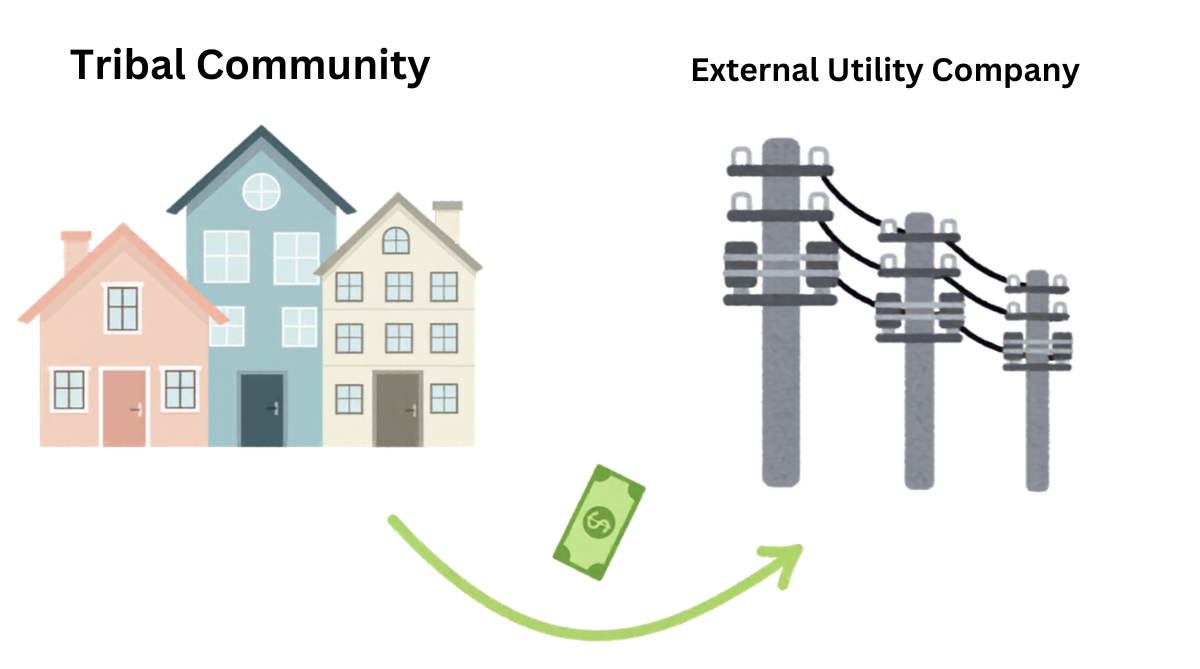
Also, many electric utilities are located off the reservation, and utility payments are sent off the reservation and are never recirculated back into the local economy. In many instances, utility payments are a one way economic drain on Native communities.
High Energy Costs: Native American households spend significantly more on energy (e.g., 45% more than white households) and face "fuel poverty," forcing choices between heating/cooling and food, notes Midwest Energy Efficiency Alliance.
In 2022, an average amount of electricity sold to a U.S. residential customer is 899 kWh per month U.S. Energy Information Administration
Energy Insecurity & Poverty: Many tribal homes lack electricity (14% lack access in the US), experience frequent outages (6.5x the national average), and have high utility rates, says the U.S. Department of Energy.
Health & Economic Consequences: High energy burdens are linked to respiratory diseases, stress, and making it harder to escape poverty, notes the Midwest Energy Efficiency Alliance.
Stay tuned for our next blogs investigating solutions to the problem of Energy Burden.
Check out Remote Energy’s Tribal Communities Programs, and Get in touch!